
Safety on the climb
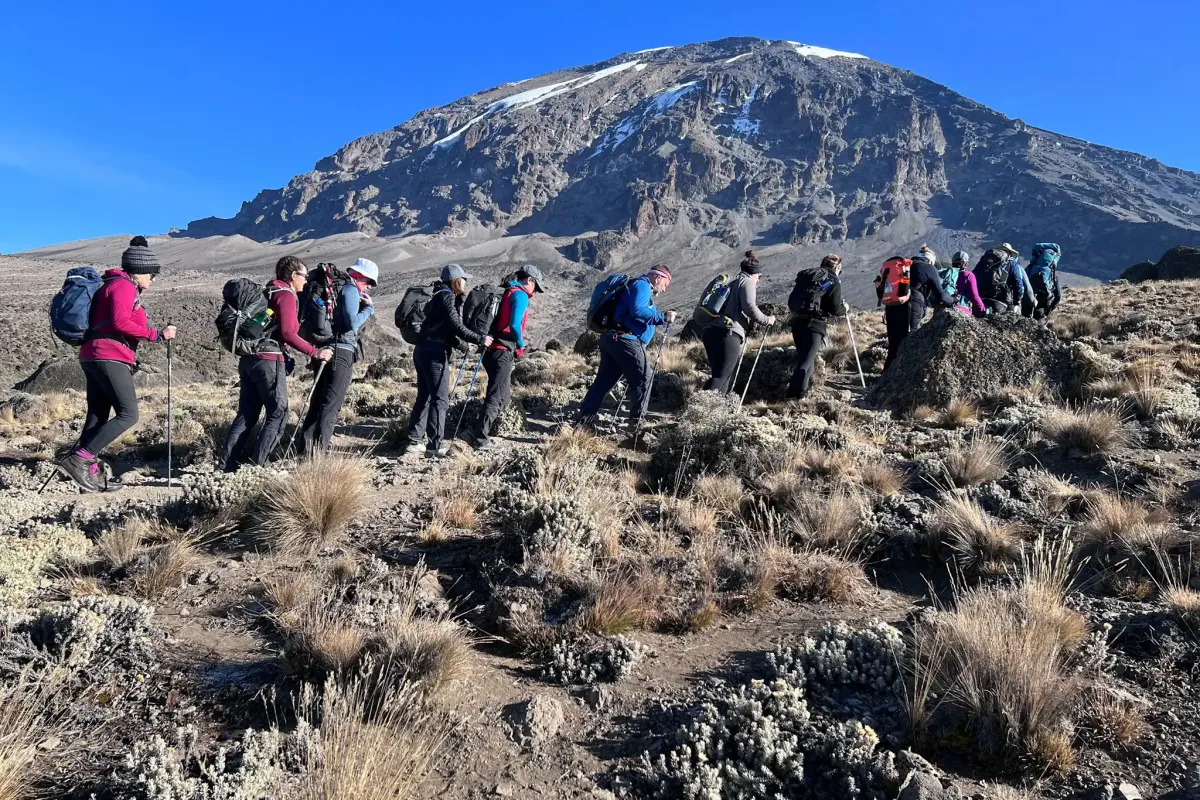
Your guides are your first line of safety. They set the pace, watch every climber for signs of altitude sickness, ask how you are feeling each day and decide whether it is safe to continue. Most problems are caught early and solved by resting, slowing down or descending a few hundred metres.
How rescue works
Walking down with a guide
Most evacuations are simple: a climber who is unwell walks down with an assistant guide — often with a porter carrying their bag — while the rest of the group carries on. Descending is the best treatment for altitude sickness, and many people feel better quickly.
Stretcher evacuation
If a climber cannot walk, park rangers and the crew carry them down by stretcher to a point where a vehicle can reach them, and on to medical care in Moshi or Arusha. The park charges a rescue fee to every climber as part of the park fees.
Helicopter evacuation
For serious cases — severe altitude illness, injuries or terrain that makes a carry-down slow — private operators can fly climbers off the mountain from several landing points, weather permitting. Helicopter evacuation is expensive and is normally paid by travel insurance, so it must be covered by your policy.
The travel insurance you need
- Trekking to at least 6,000 metres. Many standard policies stop at a lower altitude — check the limit; Uhuru Peak is 5,895 m.
- Emergency medical treatment and hospital costs, with a high limit.
- Helicopter and air evacuation from the mountain and onward to hospital.
- Cancellation and curtailment, in case you cannot travel or must leave early.
- Baggage and valuables such as cameras.
- Any safari activities or Zanzibar you add — including Zanzibar's own mandatory insurance.
Buy your policy when you book, so cancellation cover starts straight away. Declare any medical conditions to your insurer. More in our Tanzania travel insurance guide.
Before you climb
- Send us your insurer's name, policy number and 24-hour emergency number.
- Carry a copy of your policy with your passport, and save the number in your phone.
- Tell your guide about any medical conditions or medicines at the briefing.